developing hardware accelerators for artificial intelligence through optical computing architectures
introduction
The exponential growth of artificial intelligence and deep learning models has pushed conventional electronic hardware to its physical limits, particularly regarding energy dissipation and interconnected communication bottlenecks. Optical computing emerges as a promising paradigm to overcome these barriers, offering ultra-high bandwidth, sub-nanosecond latencies, and minimal power consumption by processing information using photons instead of electrons. By mapping complex mathematical operations directly onto light propagation and interference, photonics enables the acceleration of specialized computational workloads at the speed of light.
This research direction focuses on exploiting the unique physical properties of light to build next-generation computing hardware. We investigate novel architectures and device concepts that can seamlessly interface with existing machine learning frameworks, shifting the heavy computational burden from power-hungry digital electronics to efficient analog optical processors.
significance & applications
Augmenting or replacing traditional digital processors with photonic hardware can fundamentally transform data-heavy computing environments. The potential applications span large-scale AI data centers, autonomous systems requiring real-time edge intelligence, and high-frequency signal processing, where reducing latency and energy consumption per operation is paramount for sustainable technological scaling.
research focus
in-memory optical computing: designing non-von-Neumann computing architectures that integrate optical storage and processing elements to eliminate data movement bottlenecks. (e.g., (Wu* et al., 2024; Wu* et al., 2025))
activation and operator devices: developing non-linear optical components and dedicated hardware units to execute crucial activation functions and complex mathematical operations entirely in the optical domain. (e.g., (Wu* et al., 2025; Wu*† et al., 2026; Liu† et al., 2026))
photonic twins through emulation: implementing hardware-based photonic emulation systems to mirror and accelerate complex physical or computational processes with high fidelity. (e.g., (Wu† et al., 2022; Wu* et al., 2024; Wu* et al., 2025))
Photonic-assisted logic computations and emulations.
We are looking forward to new talent and fresh perspectives to join our endeavor.
References
2026
Thermo-optic dynamics of effective epsilon-near-zero media
@article{Wu2026,title={{Thermo-optic dynamics of effective epsilon-near-zero media}},author={Wu, Jiaye and Liu, Xuanyi and Clementi, Marco and Qiu, Shuang and Lin, Limin and Zhou, Zhang-Kai and Br{\`e}s, Camille-Sophie},year={2026},month=aug,journal={Advanced Photonics Nexus},volume={5},number={6},pages={066003},issn={2791-1519},doi={10.1117/1.APN.5.6.066003},lccn={1},}
Reconfigurable time-varying bleaching-channel switching in epsilon-near-zero metamaterials
@article{Liu2026,title={{Reconfigurable time-varying bleaching-channel switching in epsilon-near-zero metamaterials}},author={Liu, Xuanyi and Wu, Jiaye and Clementi, Marco and Qiu, Shuang and Lin, Limin and Garcia-Vidal, Francisco J. and Br{\`e}s, Camille-Sophie and Zhou, Zhang-Kai},year={2026},month=sep,journal={Communications Physics},volume={9},number={1},pages={in press},issn={2399-3650},doi={10.1038/s42005-026-02883-2},lccn={1},}
2025
Intracavity Epsilon-Near-Zero Dual-Range Frequency Switch
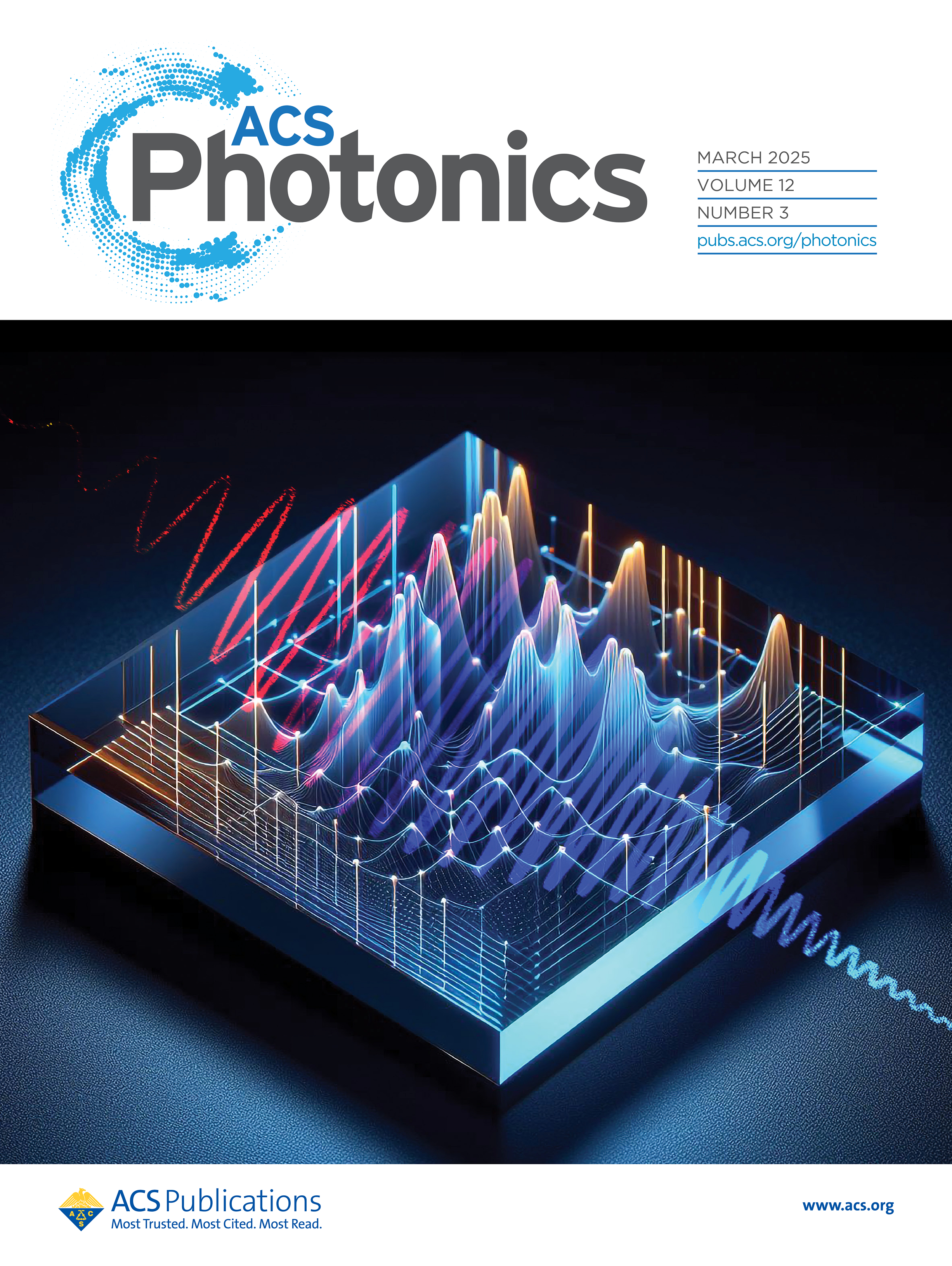
Featured journal cover of March 2025 issue. Click to view the cover art here. Download the cover art here.
@article{Wu2025,title={Intracavity Epsilon-Near-Zero Dual-Range Frequency Switch},author={Wu, Jiaye and Wang, Gang and Clementi, Marco and Zhou, Ji and Huang, Chenxingyu and Liu, Xuanyi and Fu, H. Y. and Li, Qian and Br{\`e}s, Camille-Sophie},year={2025},month=mar,journal={ACS Photonics},volume={12},number={3},pages={1276--1283},issn={2330-4022},doi={10.1021/acsphotonics.4c01322},lccn={1},}
2024
Versatile and Efficient Dual-Range Frequency Shifts by Intracavity Epsilon-Near-Zero Nanolayers
@inproceedings{Wu2024c,title={{Versatile and Efficient Dual-Range Frequency Shifts by Intracavity Epsilon-Near-Zero Nanolayers}},booktitle={{IEEE Photonics Conference (IPC)}},author={Wu, Jiaye and Wang, Gang and Clementi, Marco and Zhou, Ji and Huang, Chenxingyu and Liu, Xuanyi and Fu, Hongyan and Li, Qian and Br{\`e}s, Camille-Sophie},year={2024},month=nov,pages={1--2},publisher={IEEE},address={Rome, Italy},doi={10.1109/IPC60965.2024.10799870},urldate={2024-12-12},isbn={979-8-3503-6195-7},}
2022
Observation of SQUID-Like Behavior in Fiber Laser with Intra-Cavity Epsilon-Near-Zero Effect
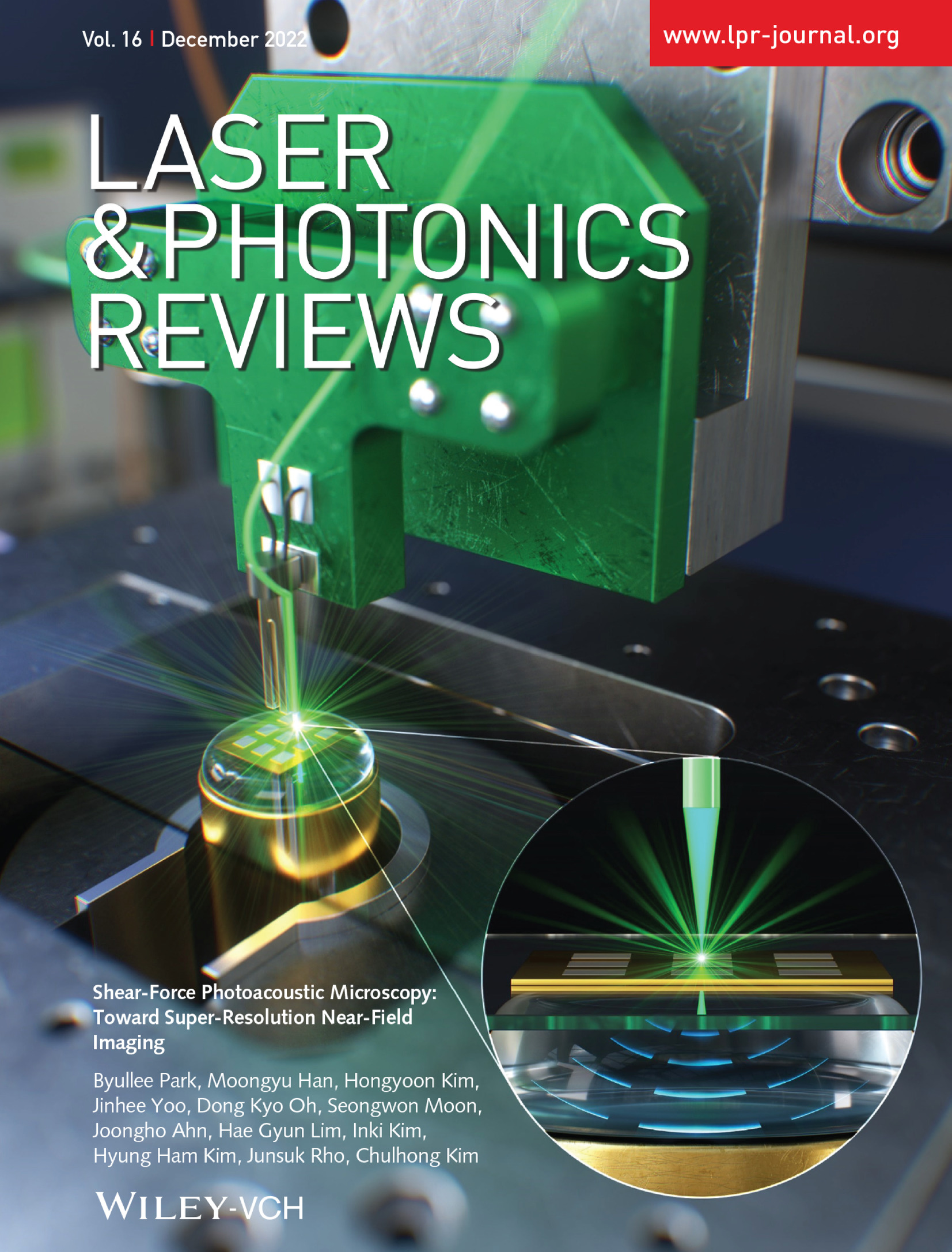
@article{Wu2022,title={{Observation of SQUID-Like Behavior in Fiber Laser with Intra-Cavity Epsilon-Near-Zero Effect}},author={Wu, Jiaye and Liu, Xuanyi and Malomed, Boris A. and Chang, Kuan-Chang and Zhao, Minghe and Qi, Kang and Sha, Yanhua and Xie, Ze Tao and Clementi, Marco and Br{\`e}s, Camille-Sophie and Zhang, Shengdong and Fu, Hongyan and Li, Qian},year={2022},month=dec,journal={Laser \& Photonics Reviews},volume={16},number={12},pages={2200487},issn={1863-8880},doi={10.1002/lpor.202200487},lccn={1},}



 Intracavity Epsilon-Near-Zero Dual-Range Frequency SwitchACS Photonics, Mar 2025